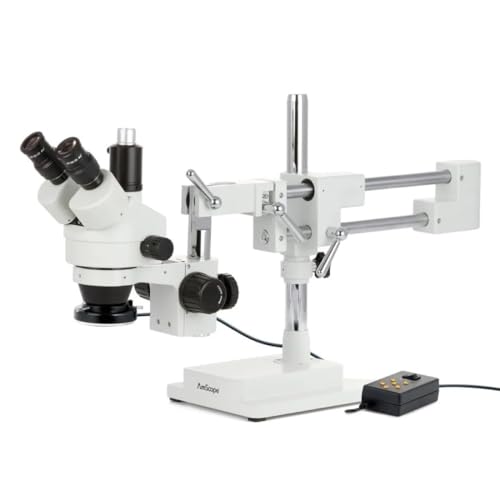
Readout
At a Glance
Bench fit
Best For
Bench fit notes
Working distance and field of view
- Working distance
- 127 mm
- Field of view
- Wide stereo field at low zoom
These two specs matter more than headline magnification for soldering, inspection, and manipulation work.
Lighting and stand behavior
- Illumination
- Built-in top/bottom; ring light recommended
- Stand stability
- Heavy, stable bench stand
Glare control and wobble usually decide whether a scope feels precise after the first week.
Overview
The short version
The AmScope SM-4TZ is the scope you graduate to when you've outgrown digital microscopy and admitted that USB scopes have a ceiling no amount of sensor resolution can fix. That ceiling is depth perception. Stereo binocular optics give your two eyes independent views of the work area, and your brain reconstructs a true 3D image of what's under the scope. The first time you solder under stereo optics after months of fighting a flat USB-screen image, you'll wonder why you waited.
The SM-4TZ has earned a near-cult following among electronics repair techs, jewelers, watchmakers, dental technicians, and serious mineral collectors because it sits at the entry point of professional-grade stereo microscopy. Below $349 the stereo-scope market is a wasteland of toy-grade Chinese imports with bad optics, sloppy mechanics, and zero trinocular options. Above $349 you're into Nikon SMZ, Leica M50, and Olympus SZX territory at $1,500+ — better optics, better mechanics, but qualitatively the same workflow.
The trinocular port is the second reason this specific model sits in so many serious hobby benches. A standard binocular stereo scope gives you the 3D viewing experience but doesn't let you capture what you're seeing. The trinocular port (a third optical path that you can install a USB camera into) lets you have both: 3D vision through the eyepieces for the actual work, and a 2D camera feed for documentation, video, or sharing the view with someone else. For under $500 with a quality 5MP camera added, the SM-4TZ becomes a complete inspection-and-documentation system that punches well above its price.
Balance sheet
Pros and Cons
Pros
05- True stereo optics — 3D depth perception that no USB-only scope can match
- 3.5x–45x zoom with trinocular port for USB camera attachment
- Large 127mm working distance — ample room for soldering under the scope
- Built-in illumination is serviceable for setup; serious soldering benefits from an LED ring upgrade
- Proven AmScope optical quality used in professional environments
Cons
04- USB camera sold separately — budget an extra $60–$100 for a quality sensor
- Bulky and heavy compared to USB-only scopes — not portable
- Requires dedicated desk space and a boom arm or table stand
- Learning curve for interpupillary distance and diopter adjustment
Why Stereo Optics Are a Different Tool Than Digital Microscopes
Stereo binocular microscopy and digital microscopy aren't competing solutions to the same problem — they're different tools that happen to overlap in price range. The AmScope SM-4TZ at $349 sits in the same price tier as the Andonstar AD409 ($199) and the upper-end digital scopes like the Tomlov DM402 ($249), and buyers regularly cross-shop them. The correct answer depends almost entirely on what you'll be doing under the scope.
A digital scope projects a 2D image to a screen. Your eyes look at the screen. The scope optics resolve a flat representation of the work area, and the depth information that exists in the real world is collapsed into a single focal plane that you adjust by focusing the optics. For inspection, documentation, and any work where you're observing rather than manipulating, this is fine — sometimes better, because the screen is large and shareable.
A stereo scope projects two slightly different views into two separate eyepieces. Your left eye sees one view, your right eye sees a slightly different view, and your visual cortex reconstructs depth the same way it does in normal vision. Under stereo optics, a soldering iron approaching a pad is visibly approaching — you can see the iron tip's distance from the pad, judge contact pressure visually, and place components with the same hand-eye coordination you'd use in normal life. Digital scopes flatten this entirely, and you have to learn to substitute timing and feel for what stereo optics give you visually.
For anything that involves manipulating something under the scope — soldering, gem-setting, watch repair, dental work, dissection, fine assembly — stereo is qualitatively better. For anything that's pure inspection or documentation, the digital scope is at least equivalent and often more useful. Many serious benches end up with both.
AmScope SM-4TZ vs SM-4NTP vs Higher Models in the AmScope Stereo Lineup
AmScope's stereo microscope catalog is large and the model numbers are confusing. The relevant comparisons for a buyer in the SM-4TZ price range are with the SM-4NTP, the SM-4TZ-FRL, and the higher-end SM-6T-FRL.
The SM-4NTP ($249) is the binocular-only version — same zoom range (3.5x–45x), same working distance (127mm), same optics, but no trinocular port. If you're certain you'll never want to attach a camera, the $100 savings is real. In practice most users who want a stereo scope eventually want a camera too, and adding the trinocular port later is impossible — you'd have to buy a whole new scope. The SM-4TZ at $100 more is the safer long-term purchase.
The SM-4TZ-FRL (~$430) adds an integrated 144-LED dual ring light around the objective. The ring light is genuinely useful — built-in illumination eliminates the need for an external lighting source and the dual-ring design lets you adjust the illumination angle for different specimens. If you don't already own the OMAX LED ring light, paying the bundle premium is a slight win over buying both separately. If you do own the OMAX ring light, the base SM-4TZ is the right choice.
The SM-6T-FRL ($599) is the next step up — wider zoom range (6.7x–45x), better optical quality at high magnification, more rigid stand, larger working distance. This is the right move for working professionals (jewelers running a shop, dentists, repair techs with the scope on the bench 8 hours a day) where the durability and optical upgrade justify the price. For serious hobby use, the SM-4TZ remains the price/performance winner.
Above $700 you're into Nikon, Leica, and Olympus territory. The optical quality differences become real (less chromatic aberration, better edge sharpness at high zoom, more consistent illumination) but the workflow doesn't change. Professional users who depend on the scope for daily revenue will see the upgrade. Hobby users typically don't.
Working Distance, Magnification Range, and What Each Actually Means at the Bench
The SM-4TZ's 127mm working distance is the most important spec on the sheet, and the spec most buyers under-appreciate. Working distance is the clearance between the objective lens and the specimen surface at the scope's standard focus point. 127mm is the difference between being able to slip a populated PCB under the scope and being able to solder with a fine-tipped iron from any angle — versus being constantly blocked by the optics.
For electronics repair specifically, 127mm gives you room for: - A fine-tip soldering iron held at a comfortable angle (you're not soldering vertically, you're approaching the pad at 30°–45° from horizontal — that needs vertical and horizontal clearance both) - Fine tweezers, vacuum tweezers, or a magnetic pickup tool to place SMD components - A stencil and squeegee for paste application on QFN reflow work - Heat gun preheating from below or hot air rework from above without bumping the optics - Visual access to the iron tip and component simultaneously, with no part of your hand blocking the optical path
A stereo scope with 60mm working distance (most low-end Chinese imports under $250) gives you maybe enough room for one of those at a time. The SM-4TZ accommodates the full rework workflow.
The 3.5x–45x zoom range is the standard stereo range for general-purpose work. The zoom dial provides continuous magnification (not stepped), so you can dial in exact magnification without losing the work in the field of view. At 3.5x you have a wide overview of an entire PCB or specimen — good for orientation, lighting setup, and broad inspection. At 45x you're at fine-pitch SMD resolution, ideal for inspecting solder joints on 0.4mm-pitch QFN or fine watch movements.
For work past 45x — bond-wire inspection on bare die, very fine watch parts, gemological inclusion mapping — you can add a 2x supplementary objective ($60) that increases the zoom to 7x–90x without losing the trinocular function. Above that you're crossing the boundary into research microscopy where compound (not stereo) optics start making more sense.
Field of View and Supplementary Objectives
The exact field of view depends on eyepieces, zoom setting, auxiliary objective, and camera adapter. Verify the field with a stage ruler or calibration slide if you plan to document dimensions. For normal soldering and watch work, the lowest zoom settings are often more useful than buyers expect because they preserve context around the work area.
A 0.5x auxiliary objective generally increases working distance and field of view while reducing magnification, which can make soldering and inspection more comfortable. A 2x objective does the opposite: it increases magnification while reducing clearance and field. That tradeoff is useful for very small features but can make tool access worse. Buy the auxiliary lens for the workflow problem you actually have, not for a bigger magnification number.
Adding a Camera to the Trinocular Port: What You Actually Need
The SM-4TZ trinocular port is a 23.2mm photo tube (standard stereo microscope sizing). Adding a USB camera requires three components: the camera itself, a C-mount-to-23.2mm adapter, and a 0.5x or 0.35x reduction lens to match the camera sensor size to the optical field of view. This isn't complicated but it's not plug-and-play either, and AmScope's documentation glosses over the optical adapter requirements in a way that frustrates first-time buyers.
The recommended camera depends on what you're capturing. For static documentation (photos for catalog records, repair documentation, insurance photos), the AmScope MU500 (5MP, ~$200) is the standard recommendation — it ships with the right adapters and the bundled software (ToupView) has measurement calibration tools that work out of the box.
For live video capture (YouTube content, instructional videos, real-time bench-share with a remote collaborator), a higher frame rate matters. The AmScope MU1000 (10MP at 30fps) or third-party HDMI cameras (Hayear, Tomlov stand-alone cameras) deliver smoother live feed at the cost of slightly worse still-image resolution. For YouTube production, most stereo-scope users land on a dedicated HDMI camera with a small external monitor — the camera goes in the trinocular port, the HDMI feeds the monitor, and the camera's HDMI output can be captured by a separate device for recording.
For the cheapest path: any C-mount industrial USB camera (the same kind used for machine-vision applications) works fine with the appropriate adapter. Eakins and BBKing brand cameras on Amazon at $80–$120 produce acceptable image quality for hobby use, though their software is uniformly bad and most users end up driving them through generic UVC apps anyway.
The camera setup is the part of stereo microscopy that most buyers underestimate. Budget $150–$300 on top of the scope for a camera setup that actually works.
Watchmaking, Jewelry, and Other Use Cases Beyond Electronics
While electronics repair is the most-discussed use case for the SM-4TZ in online forums, the scope was originally designed for and remains widely used by jewelers, watchmakers, dental technicians, and serious mineral hobbyists. These use cases benefit from stereo optics for many of the same reasons electronics repair does — manipulation under magnification requires depth perception.
Watchmakers use the SM-4TZ for movement inspection, escapement adjustment, balance staff work, and especially for fitting hands without bending them. The 127mm working distance accommodates the watch movement holder and small tools simultaneously. The 3.5x–45x range covers the magnification needs for everything from general movement inspection to fine pivot work. The trinocular port is widely used in watchmaker forums and YouTube channels for documenting repairs and sharing techniques with other watchmakers.
Jewelers use it for setting stones (depth perception is essential for prong work), prong inspection on existing pieces, gemstone examination, and bezel-setting work. The scope is durable enough for daily professional use, though shops with high-volume gem inspection often upgrade to a binocular gem microscope with dark-field illumination at $700+.
Dental technicians use it for crown and bridge work, framework adjustment, and articulator inspection. The 127mm working distance is sufficient for most dental lab work, and the stereo optics make fine carving and shaping operations dramatically easier than working with magnifying loupes or single-eye scopes.
Mineral collectors use it for specimen examination, identification work, and micromount viewing. The 3.5x–45x range overlaps with the typical micromount magnification window perfectly. Trinocular documentation lets collectors build photo-cataloged collections for trade, sale, or insurance records.
The scope works across all of these use cases because stereo optics solve the same problem (manipulation under magnification) regardless of what you're manipulating. The price-performance value is what makes the SM-4TZ specifically the entry point for serious work in all of these fields.
Verdict
Our Verdict
The AmScope SM-4TZ is what you buy when you've outgrown USB microscopes. The stereo optics provide real depth perception that transforms fine soldering, watch repair, and mineral inspection. At $349 with a trinocular port, it's the entry point to professional-grade magnification.
Full readout
| Full Specifications | |
|---|---|
| Working Distance | 127mm |
| Illumination | Built-in top/bottom; ring light recommended |
| Stand / Mount | Table stand stereo microscope |
| Stand Stability | Heavy, stable bench stand |
| Magnification | 3.5x–45x |
| Field of View | Wide stereo field at low zoom |
| Camera Resolution | Camera sold separatelyMP |
| Frame Rate | Camera sold separatelyfps |
| Screen Size | Nonein |
| Connection | Trinocular (camera sold separately) |
| Built-in Screen | No |
| Camera Included | No |
| Calibration Support | Camera-port measurement after calibration |
| Mount Thread | — |
| LED Count | — |
| Brightness Control | — |
| Color Temperature | — |
| Power | — |
| Stand Included | Yes |
| Weight | 4.8kg |
Buying call
AmScope SM-4TZ Trinocular Stereo Microscope
Best if you need 127 mm working distance with Built-in top/bottom; ring light recommended for electronics repair.
Prices may change · Check current Amazon listing before buying
FAQ
Frequently Asked Questions
Is the AmScope SM-4TZ worth it for SMD soldering compared to the Andonstar AD407?
Can I use the AmScope SM-4TZ without buying a separate camera?
Does the SM-4TZ come with adequate lighting?
Is the AmScope SM-4TZ good enough for jewelry-making and gemstone work?
Go deeper
Related Buying Guides
Versus