Readout
At a Glance
Bench fit
Best For
Bench fit notes
Working distance and field of view
- Working distance
- 127 mm
- Field of view
- Accessory; depends on microscope
These two specs matter more than headline magnification for soldering, inspection, and manipulation work.
Lighting and stand behavior
- Illumination
- 144-LED dual ring
- Stand stability
- Mounts to compatible stereo scope
Glare control and wobble usually decide whether a scope feels precise after the first week.
Overview
The short version
Microscope lighting is the single highest-leverage upgrade you can make to a bench scope, and the OMAX 144-LED dual-ring is the $34 fix that turns a frustrating image into a usable one. Most users discover this the hard way — they buy a $200 stereo scope, the images look flat and washed out, they assume the optics are the problem, and they spend another $400 upgrading the scope. The real problem was almost always the lighting.
A microscope's optics can only resolve what light actually reaches the specimen. The factory built-in illumination on most stereo and digital scopes is single-source, single-angle, and usually too dim — fine for biology slides where transmitted light from below handles most of the work, but a disaster for reflective subjects like solder joints, polished minerals, watch movements, or PCB traces where the angle and quality of incident light determines whether you see surface detail or just see glare.
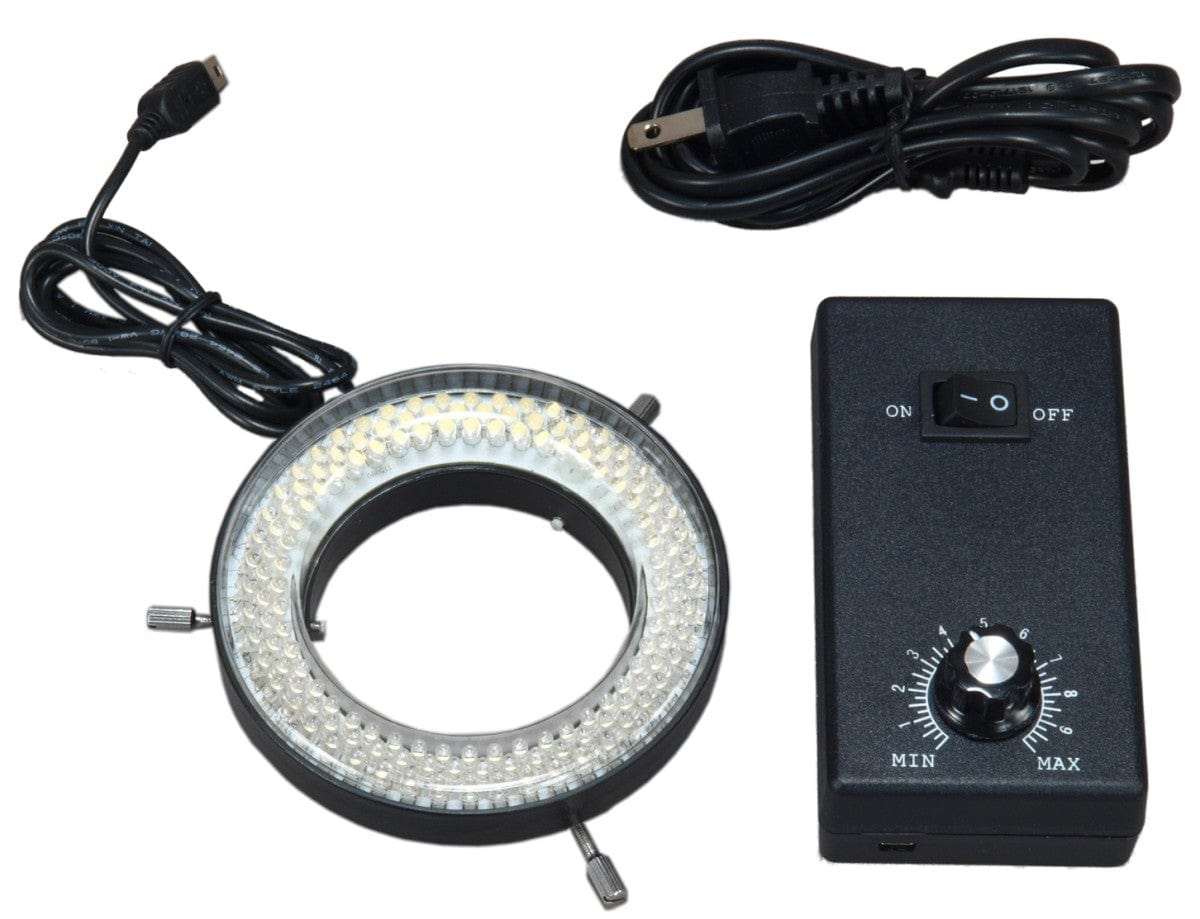
The OMAX 144-LED solves this with brute force and good design. 144 white LEDs arranged in two concentric rings (72 inner, 72 outer) with independent brightness controls. Threading directly onto the microscope objective at the standard 48mm filter mount, it provides bright, even, fully adjustable illumination from the same angle as the optical axis. The dual-ring control is the part that actually matters — you can dial up one ring and dial down the other to create oblique illumination that reveals surface texture invisible under flat ring-light alone.
Balance sheet
Pros and Cons
Pros
05- 144 LEDs in two independently controlled rings — dial in the exact illumination angle
- Fits any microscope with standard 48mm thread size
- Dramatically improves image quality on metallic or reflective specimens
- Separate brightness controls for inner and outer ring enable oblique lighting
- Metal construction — no plastic flexing or wobble
Cons
03- Requires 12V DC adapter (included) — adds one more cable to your bench
- Inner ring diameter may not fit all consumer USB microscopes without adapter
- No color temperature adjustment — pure white LEDs only
Why Microscope Lighting Matters More Than Magnification
Microscope users new to the hobby tend to evaluate scopes on magnification and resolution numbers, but the experienced reality is that lighting determines image quality more than either. A $1,000 scope with bad lighting produces worse images than a $200 scope with proper illumination. This is true at every level of microscopy from hobby to professional.
The physics: microscope optics gather and amplify whatever light is reflected or transmitted from the specimen. Higher magnification means a smaller area of specimen contributes the same total light to the image. Without proportionally brighter illumination, high-magnification images get progressively dimmer and noisier. This is why scopes that look fine at 4x become unusable at 40x — not because the optics break down (they don't), but because the available light per unit area drops by the square of the magnification ratio.
The quality of the light matters as much as the quantity. Flat front-on lighting from a single ring at the lens face washes out surface texture — every point on the specimen is lit from the same angle, so all surface features look uniform. Oblique lighting (light coming in at an angle to the optical axis) creates shadows that reveal texture. The OMAX dual-ring control lets you dial in the ratio of front-on to oblique illumination, which is the difference between seeing a flat-looking solder joint and seeing whether the joint is properly wetted with a visible fillet.
For reflective specimens — solder, polished minerals, metal parts, watch movements, gem facets — oblique lighting reveals defects, surface roughness, and edge detail that flat lighting hides completely. For diffuse specimens — biology samples, paper, fabric — flat ring lighting is usually preferred. Having both control modes in a single fixture is what makes the OMAX 144-LED a genuinely useful tool across use cases.
Installation, Compatibility, and the 48mm Standard
The OMAX 144-LED uses a 48mm threaded mount that fits the standard objective filter thread used by AmScope, Omano, Bausch & Lomb, Nikon SMZ-series, Olympus SZ-series, and most other stereo microscopes from the 1980s onward. This is the de facto standard for stereo microscope accessories, and the OMAX ring physically fits almost any scope that doesn't have a fundamentally non-standard objective design.
For scopes that don't have 48mm threads (some Chinese imports, some older European scopes, some compound microscopes designed primarily for slide work), OMAX sells thread adapters and friction-fit collars. Check your scope's objective specification before ordering — the listing assumes 48mm and won't necessarily fit otherwise. Most users won't have a problem; this is the standard size for the SM-4TZ and the entire AmScope SM series.
For USB digital microscopes (Andonstar AD407, AmScope ME300, Tomlov scopes), the OMAX is generally not the right tool. Digital scopes typically have their own integrated LED ring built into the lens assembly, and threading an external ring around the camera lens is mechanically awkward (and often impossible). For digital scope lighting upgrades, the better path is usually an external LED bar or panel set to oblique illumination from the side.
The OMAX ring includes a 12V DC adapter (US-style wall plug, ~3 feet of cable). The power supply is reliable but adds one more cable to your bench. Some users replace the wall-wart adapter with a USB-C-to-12V trigger cable to power the ring from a USB-C power supply alongside other bench accessories — this is a $10 upgrade that cleans up the cable mess significantly. The OMAX cable connects via a standard 5.5mm × 2.1mm DC barrel jack, so any 12V supply with that connector works.
Fit Check Before Buying
Measure the objective thread before ordering. The OMAX is the right purchase only when your stereo microscope has 48mm objective threads or a known adapter path. If the scope has a smooth objective housing, a non-standard thread, or an integrated camera lens, the ring may not mount securely or may illuminate the wrong plane.
For AmScope SM-series stereo scopes, 48mm compatibility is the reason this accessory is popular. For USB digital scopes, use an external LED bar or side panel instead. Side lighting lets you control glare without trying to force a threaded stereo accessory onto a camera-style microscope.
Real Use: When Each Ring Configuration Matters
Both rings on, full brightness, equal mix — this is the default for general inspection work. Bright, even illumination from the lens axis. Works well for biology specimens, broad inspection of PCBs at low magnification, initial orientation when you're scanning a specimen looking for features of interest. About 80% of microscope work happens at this setting.
Inner ring only — narrow-angle illumination that approximates a coaxial light source. Best for very small features at high magnification where you need maximum light on the smallest possible area. Useful for inspecting solder joints at 30x–45x on a stereo scope, examining gem inclusions, or reading very small part markings. The trade-off is some specular reflection from shiny surfaces, but the concentrated light reveals fine detail that the broader dual-ring mix can wash out.
Outer ring only — wider-angle illumination that lights the specimen from a steeper angle relative to the optical axis. Creates noticeable shadows that reveal surface texture. Best for inspecting solder wetting (you can see whether a solder joint actually formed a proper fillet), reading texture on minerals, examining mechanical surface finishes, or distinguishing surface scratches from deeper defects. This is the mode that experienced users dial up when they're looking for problems on a finished surface — defects that hide under flat lighting jump out under oblique lighting.
Inner low, outer high — the experienced-user setting for serious solder inspection. The high outer ring creates strong oblique lighting that reveals joint geometry, while the low inner ring fills the deeper shadows enough to keep the image readable. This setting takes a few sessions to develop a feel for, but once you've used it for a while you start seeing solder defects that you missed for years with conventional lighting.
Uneven left-right setup — if your inner and outer rings are individually controllable (which the OMAX 144 is) and you're willing to physically rotate the ring relative to the scope, you can create directional lighting that simulates side-illumination from a specific direction. Useful for revealing very subtle surface features where you want shadows to fall in a controlled direction. This is advanced technique territory but the hardware supports it.
Color Temperature, Color Rendering, and the Limits of the OMAX
The OMAX 144-LED uses standard white LEDs without color temperature adjustment. The color temperature is in the 5500K–6500K range (cool white, daylight balance). This is fine for inspection work, photography, and most documentation, but it's a real limitation for serious specimen photography where matching the white balance of your camera matters.
For mineral and gem photography specifically, the lack of color temperature adjustment is occasionally frustrating. Some gem species (alexandrite, certain garnets, color-change sapphires) appear different colors under different illumination — daylight versus tungsten versus fluorescent — and the photographic record needs to specify illumination type. With a fixed cool-white LED you can't reproduce these color-change phenomena photographically. For specialized gem work, dual-color LED rings (with both cool-white and warm-white LEDs controllable separately) are the upgrade path; they cost $80–$150 and offer adjustable color temperature.
Color rendering index (CRI) is the second technical consideration. Generic white LEDs have moderate CRI (around 70–80) — sufficient for general work but not great for color-critical applications. For gem grading, photo documentation of biological specimens, or any work where accurate color reproduction matters, higher-CRI dedicated microscope lights (Schott KL series, Dolan-Jenner Fiber-Lite) outperform the OMAX significantly. These cost $200–$500 and are the upgrade path for serious specialized work.
For general electronics repair, mineral inspection, watchmaking, and hobby microscopy, the OMAX's color rendering is fine. Color accuracy isn't the limiting factor for these use cases; brightness and angle control are. The OMAX delivers both at a price point nothing else matches.
Who Should Buy This and Who Should Look Elsewhere
Buy the OMAX 144-LED if you own a stereo microscope with 48mm objective threads (AmScope SM series, most generic stereo scopes) and the built-in illumination isn't satisfying you. The improvement is immediate, the cost is trivial, and the dual-ring control opens up image quality that you can't reach with single-source lighting. This is the no-brainer first upgrade for anyone serious about their stereo scope.
Buy it if you're shopping for the AmScope SM-4TZ (reviewed elsewhere in this lineup) and trying to decide between the base model and the SM-4TZ-FRL with built-in ring light. Buying the base SM-4TZ ($349) plus the OMAX 144-LED ($34) saves $50 over the SM-4TZ-FRL bundle, and the OMAX is at least as good as the integrated ring. The trade-off is one extra cable on the bench.
Don't buy it for a USB digital microscope (Andonstar AD407, AmScope ME300, Tomlov scopes). These have their own integrated LED rings around the camera lens and the OMAX won't physically mount in a useful position. For digital scope lighting upgrades, look at external LED light bars or polarizing filters instead.
Don't buy it for color-critical work. The fixed cool-white LEDs lack color temperature adjustment, which matters for gem photography, color-accurate biological documentation, and certain mineralogical work where illumination spectrum affects perceived color. For those use cases, step up to a dual-color or fiber-optic illuminator at $100–$300.
Don't buy it if you're using a compound microscope (Swift, Motic, Nikon Eclipse, AmScope T-series). Compound scopes use transmitted illumination from below the stage; a top-mounted ring light doesn't address the actual illumination geometry. For compound microscope upgrades, look at upgraded condensers or substage illuminators instead.
The OMAX 144-LED hits its target use case (stereo microscope lighting upgrade) better than anything else at twice the price. Within that use case it's the right tool. Outside it, look elsewhere.
Verdict
Our Verdict
If stereo microscope images look flat or washed out, lighting is often the problem. The OMAX 144-LED ring light is a high-leverage upgrade for 48mm-thread stereo scopes at $34. Check fit before buying, then add it before blaming the optics.
Full readout
| Full Specifications | |
|---|---|
| Working Distance | 127mm |
| Illumination | 144-LED dual ring |
| Stand / Mount | 48mm objective-thread accessory |
| Stand Stability | Mounts to compatible stereo scope |
| Magnification | N/A |
| Field of View | Accessory; depends on microscope |
| Camera Resolution | N/AMP |
| Frame Rate | N/Afps |
| Screen Size | Nonein |
| Connection | 12V DC |
| Built-in Screen | No |
| Camera Included | No |
| Calibration Support | No measurement calibration |
| Mount Thread | 48mm |
| LED Count | 144 |
| Brightness Control | Dual ring |
| Color Temperature | Cool white |
| Power | 12V DC |
| Stand Included | No |
| Weight | 0.28kg |
Buying call
OMAX 144-LED Ring Light with Adjustable Arm
Best if your stereo microscope has compatible 48mm threads and glare is limiting surface detail.
Prices may change · Check current Amazon listing before buying
FAQ
Frequently Asked Questions
Does the OMAX 144-LED ring light fit the AmScope SM-4TZ?
Can I use the OMAX 144-LED with a USB microscope like the Andonstar AD407?
Is the OMAX 144-LED better than the AmScope LED-144W ring light?
What color temperature is the OMAX 144-LED ring light?
Versus